

An importer in Seoul shipped 3,000 home treadmills into a market where most buyers live in flats. Warranty claims on the motor were almost none. Within six weeks the returns and one-star reviews all told the same story: the neighbour downstairs. Nobody returned a machine for being slow. They returned it for being loud in a way the spec sheet never mentioned, and the importer paid both legs of freight. In an apartment market, noise is not a comfort feature, it is the product.
Where Treadmill Noise Actually Comes From
Four sources, and only one is the motor. Motor whine is tonal, sits somewhere around 1 to 4 kHz, and is more irritating than its dB figure suggests. Belt on deck friction climbs as the belt dries, so a machine that is quiet on day one can be 5 dB louder within three months. Footfall impact is the biggest energy source at roughly two to three times user body weight per stride. Then deck flex turns the frame into a sounding board.
Only the first two are airborne. The last two go into the floor, and that split is where import programmes fail, because the factory quotes an airborne figure and the customer complains about the other. Where a home treadmill with a shock absorbing deck is being specified, ask which of the four the cushioning addresses, since elastomer under the deck does nothing for motor whine.
Airborne dB Is Not the Number That Gets You Returned
Airborne sound is what a microphone hears in the room. A typical home treadmill measures 60 to 65 dB(A) at 1 m at 6 km/h walking and 70 to 75 dB(A) at 10 to 12 km/h. Those figures are similar across competitors and are not what drives returns. Structure-borne vibration travels through the frame into the slab or the joists and radiates from the ceiling below as a low thud.
Specify the measurement or the number is worthless. Require A-weighted dB at 1 m from the deck, 1.5 m above the floor, slow response, background below 35 dB(A), taken at a defined speed after ten minutes of warm-up. Then require a second reading in the room below. A machine reading 68 dB in the room and 55 dB below is a different product from one reading 68 and 62, and only one survives an apartment market.
Cushioning: What Elastomers Really Buy You
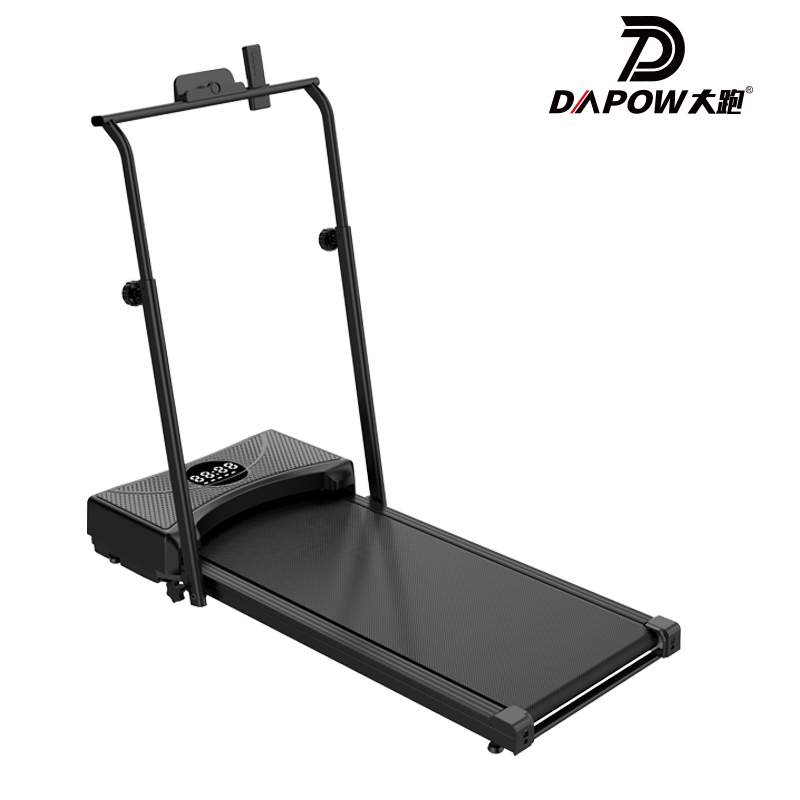
Cushioning is sold as comfort and is really a trade-off. Elastomer mounts between deck and frame attenuate the footfall pulse, typically taking 2 to 4 dB off the structure-borne reading. The cost is a slightly softer push-off, which heavier runners notice and often dislike.
Ask what the elastomer is and where it sits. Durometer, mount count and position along the deck matter more than the marketing name, and mounts under the front third where the foot lands do most of the work. Ask for compression set data after 100 hours, because elastomer that takes a permanent set becomes a hard spacer and the machine gets louder with age. A home running treadmill aimed at serious runners often runs a firmer setup for exactly this reason.
Deck, Frame and Weight Do More Than Cushioning
The most reliable noise control is mass and stiffness. A 15 mm deck flexes, an 18 mm deck flexes less and a 25 mm deck barely moves, and a flexing deck pumps energy into the floor at every stride. Frame geometry matters just as much: a twin-leg frame with two uprights resists the torsional wobble that a single-leg frame drives straight down through its feet.
Weight is not a defect here. A 70 kg machine bounces, a 100 kg machine sits, and the heavier unit measures quieter below because it is harder to excite. At the top of the range, a luxury wide home treadmill beats a light equivalent on the reading that matters, provided the floor underneath can take the load.
Floor Load Is a Structural Question
A 120 kg machine is not a problem because of the number, but because of where the load lands. Domestic timber floors are commonly designed for a distributed imposed load near 1.5 kN/m², about 150 kg/m², but a treadmill delivers point loads through four small feet plus a dynamic pulse of two to three times body weight. On a concrete slab none of this matters. On timber joists at 400 mm centres it does.
Two rules solve this. Fit a dense rubber or TPE mat of 6 to 10 mm, never soft foam, to spread the point loads and break the direct path into the joists. And specify placement near a load-bearing wall or over a joist line, never at mid-span. A machine at mid-span on a timber floor is heard two rooms away however quiet its motor is.
The Specs to Put in the Purchase Contract
Write these into the contract and require a test report for each before the first shipment.
- dB(A) at 1 m at 6 km/h and at 10 km/h, with the method stated.
- dB(A) in the room below, same session, same speeds.
- Deck thickness in millimetres and the mount specification.
- Net weight and folded footprint in millimetres.
- Recommended mat: material, thickness and density.
- Lift and doorway dimensions for the target market, checked against the carton.
- Belt lubrication interval and the dB rise allowed before service.
The Bottom Line
The listing is where the return is prevented. State dB at a named speed and distance instead of a bare quiet motor claim, publish the mat as a required accessory, put folded dimensions next to lift dimensions, and add one line about floor type. Importers who do this watch return rates fall without changing the product. A folding home running treadmill sold that way outsells a quieter machine sold on a vague spec sheet, because a buyer who knows what to expect does not return the box.
Related Pages
- How to Choose Treadmills for Corporate Wellness Programs
- How to Source Treadmills for Amazon FBA and Online Marketplaces
- Private Label Opportunities for Walking Pads and Compact Treadmills
Post time: Sep-10-2026