

The Buyer Who Did Not Want a Treadmill
A facility manager for a senior living group was asked to source exercise equipment and rejected every running treadmill in the catalogue. The reasons were consistent and had nothing to do with the machines: the top speed was unnecessary and alarming, the units were too heavy to move, and there was nowhere to put a console anyone could learn in five minutes. The buyer wanted a walking device, and every product shown was a running machine that happened to have a slow setting.
Importers working the home fitness category run into this repeatedly. The assumptions baked into a running treadmill specification are wrong for a large and growing group of buyers, and those buyers are not price sensitive in the way a home fitness shopper is. Selling into offices, clinics and senior living requires a different specification conversation, and importers who make that shift open a channel that does not compete on the same terms as consumer retail.
What Actually Changes for a Low-Speed Buyer
Five things, and each one removes a feature that a running buyer would consider essential.
Maximum speed is a safety parameter, not a performance one. A device that cannot exceed a walking pace removes the need for a safety key logic that alarms, removes a category of user error, and makes the unit approvable by a facilities or clinical reviewer. This is often the single fact that wins the order.
Step-up height and handrail access come next. A user with limited mobility needs a low deck and something to hold on the way on and off. A deck that is comfortable for a runner can be an access barrier for the buyer who actually needs the device, and this is the most common reason a unit is returned from a care setting.
Console simplicity follows. A single large display showing time, speed and distance with a physical button is correct here; a touchscreen with programme libraries is a liability. Buyers in this channel consistently report that the simpler console is the one that gets used.
Noise matters more than in a home gym. An office or a shared corridor has an acoustic standard that a spare room does not. Specify the motor and belt combination for quiet running and publish a noise figure, because “quiet” without a number will be tested by the buyer’s own facilities team.
Portability and storage close the list. These units are moved daily, stored upright, and shared between users. Weight, wheels and folded footprint are specification fields that decide the purchase as often as the motor does.
A compact unit such as the DAPOW 2138-401A electric walking pad is designed around exactly this set of priorities, and it should be quoted on noise, deck height and storage footprint rather than on top speed.
Channel One: Offices and Workplaces
The workplace buyer is a facilities or HR manager, and the purchase is justified as a wellbeing benefit rather than as fitness equipment. What that buyer needs is a unit that fits under a desk or in a wellness room, that anyone can use without instruction, and that will not generate a noise complaint or an insurance question.
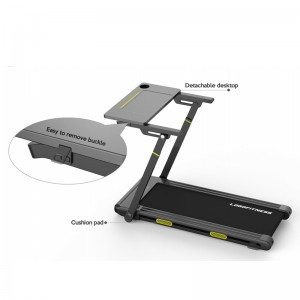
Under-desk configurations dominate here, and the specification should cover the clearance height in use, whether the unit can be stored vertically against a wall, and whether the belt starts from rest smoothly at low speed. A jerky start at low speed is the most frequent complaint in workplace installations, and it is a motor control question the importer should raise before quoting.
A model such as the DAPOW 1938 compact walking pad suits a shared wellness room where several people use the same unit through the day.
A dedicated under-desk design like the DAPOW 0340 office treadmill with desktop is what a workplace buyer actually means when they ask for a walking workstation, and it should be quoted on clearance height and start-up smoothness rather than on motor power.
Channel Two: Clinics and Rehabilitation
The clinical buyer is the most demanding and the least price sensitive. This buyer needs documented speed accuracy, a handrail rated for load, a non-slip surface, and a device that can be cleaned between patients. Procurement will ask for a specification sheet with those fields filled, and an importer who supplies it will clear a process that excludes most consumer brands.
Speed accuracy is the item most often missed. In a gait or rehabilitation context, a displayed speed that is ten percent off is a clinical problem rather than a marketing one. Confirm the tolerance and state it in writing, because a clinic will test it in the first week.
A unit with a handrail such as the DAPOW 0440 walking pad with armrests is the minimum configuration for this channel, and the handrail load rating should be treated as a certified figure rather than an assumption.
Channel Three: Senior Living and Assisted Care
Here the buyer is managing risk for a population, and the whole specification is about removing the ways a user can be hurt. Low deck, handrail, limited top speed, a large emergency stop and a belt that starts and stops gradually: those five items are the product.
The commercial detail that matters is who maintains it. A care operator will ask what happens when it needs service, and an importer who can offer a spare parts list and a service document will win over one who offers only a warranty card. In this channel the availability of a drive belt and a controller in year three is a purchase criterion, not an afterthought.
A mild incline option has a place here too, because a small gradient changes the exercise value without raising speed. The DAPAO 1438 mini walking pad with three level manual incline gives a care setting that option without adding the complexity of a motorised lift mechanism that can fail.
What the Importer Should Change in the Offer
Three changes open this channel without any product development. Rewrite the specification sheet to lead with deck height, top speed, noise figure, handrail load rating and folded footprint instead of horsepower. Prepare a cleaning and maintenance document. And quote in multi-unit quantities with a one year spare parts kit attached.
Where the buyer wants a single device that can serve both a walking and a light jogging user, a 2-in-1 configuration such as the DAPOW TW140B walking pad covers both, but it should be presented as a compromise rather than as the recommended option for a care setting, because the raised top speed reintroduces the very risk this channel is buying away from.

The Takeaway
The non-gym channel is not a smaller version of the home fitness channel; it is a different specification with different acceptance criteria. Lead with access, noise, console simplicity and serviceability rather than with speed and power, and the office, clinic and senior living buyers become a channel that orders in volume and does not shop on price.
Related Pages
- How to Choose Treadmills for Corporate Wellness Programs
- How to Source Treadmills for Amazon FBA and Online Marketplaces
- Private Label Opportunities for Walking Pads and Compact Treadmills
Post time: Oct-15-2026