

Within the global fitness distribution and retail chain sectors, the inversion table is classified as a high-ticket, safety-critical rehabilitation device. For B2B buyers, evaluating a high-quality inversion table requires moving beyond catalog photos and ex-factory pricing. Instead, procurement decisions must focus on structural integrity, biomechanical alignment, and regulatory compliance. This guide outlines the essential technical parameters for sourcing premium inversion tables, covering weight capacity, frame construction, ankle locking systems, backrest padding, and height adjustability. It serves as a reusable checklist for distributors and wholesalers targeting the North American, European, and Australasian markets.
1. Weight Capacity and Frame Structural Integrity
Maximum User Weight Capacity is the primary safety threshold. Premium inversion tables typically offer ratings of 300 lbs (136 kg), 330 lbs (150 kg), or 350 lbs (158 kg). Distributors should apply a safety margin of 20%–30% above the target market’s average user weight. For the North American home fitness segment, prioritizing models rated at 300 lbs is standard, while a 350 lbs rating serves as a strong selling point for heavy-duty lines.
Frame material dictates long-term torsional stability:
-
Heat-Treated Steel: High-end units utilize thick-walled square steel tubing (minimum 2.0 mm wall thickness). Square profiles offer superior torsion resistance compared to round tubes.
-
Weld Quality: Look for continuous full welds rather than spot welding. Surfaces should feature powder-coating for corrosion resistance.
-
Pivot Points: High-stress joints require heavy-duty steel hinges or sealed bearings.
-
Red Flag:Thin-gauge round tubing, visible flex during inversion, and lack of anti-corrosion treatment indicate low-quality imports unsuitable for professional retail channels.
When requesting quotations, insist on precise specifications: tube dimensions, wall thickness, steel grade (e.g., ASTM equivalent to Q235B), and net weight (quality residential units typically weigh between 64–75 lbs / 29–34 kg).
2. Inversion Angle Adjustment and Center of Gravity
High-quality inversion tables emphasize controlled rotation over maximum angle. Safety and usability are defined by:
-
Adjustable Rotation: Systems typically feature preset positions (20°, 40°, 60°, 90°) combined with a tether strap for free-form adjustment. This allows users to progress gradually, which is crucial for therapeutic use.
-
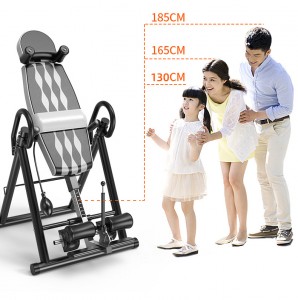
Center of Gravity Calibration: The rotational axis must align with the user’s center of gravity. Therefore, a robust height adjustment system is mandatory. Premium models accommodate users from 4’8″ to 6’6″ (142–198 cm). Look for clearly marked height scales on the main shaft rather than ambiguous slider markings.
3. Ankle Locking System: The Critical Safety Interface
The ankle locks are the sole connection point supporting the user’s full body weight; their design supersedes even backrest comfort in importance.
-
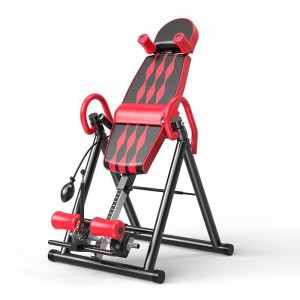
Ergonomic Design: U-Shaped Ankle Cups with padded foam rollers distribute pressure across the shin and Achilles tendon, avoiding direct pressure on the ankle bones.
-
Dual-Lock Security: A primary ratchet lock combined with a gravity-activated secondary lock prevents accidental release during transitions.
-
Accessibility: Handles should be front-mounted or side-mounted, allowing users to secure themselves without twisting their torso after lying down.
-
Padding Density: High-resilience EVA foam offers the best balance between cushioning and support.
4. Backrest Padding and Lumbar Support
A premium inversion table does not necessarily have the thickest pad, but rather the most supportive structure.
-
Base Layer: High-density foam (typically 40–60mm) covered in durable, non-slip PU leather or breathable mesh.
-
Functional Features: Removable lumbar bridges or acupressure nodes enhance spinal decompression. Advanced models may feature FlexTech suspension systems to reduce stress on the back and knees.
-
Dimensions: Standard widths range from 26″ to 31″ (67–78 cm). Excessively narrow pads restrict shoulder movement, while overly wide pads compromise foldability.
Procurement teams should request foam density (kg/m³) and resilience rates rather than accepting generic descriptions like “extra thick.”
5. Dimensional Metrics: Height Range, Footprint, and Storage
Beyond weight limits, two sets of dimensions must be standardized in purchase contracts:
-
User Height Range: Standard high-quality units cover 4’8″ to 6’6″ (142–198 cm).
-
Assembled Dimensions: Length typically ranges from 61″ to 88″ (154–224 cm); height from 61″ to 81″ (155–206 cm).
-
Folded Dimensions: For warehouse efficiency, look for units folding down to a depth of 8″ to 12″ (20–30 cm). Integrated transport wheels are a significant value-add for home users.
6. Safety Certifications and Regulatory Compliance
Entry into Western retail channels requires verifiable third-party certification:
-
EN ISO 20957-1: The European standard for stationary training equipment (Class S indicates professional/commercial grade robustness).
-
UL / ETL Certification: Required for units featuring electronic components (heat/vibration).
-
FDA Registration: In the U.S., inversion tables are often registered as Class I Medical Devices (referencing brands like Teeter).
-
CE / UKCA Marking: Mandatory for the EU and UK markets.
-
Warning Labels: Instructions must explicitly list contraindications (hypertension, glaucoma, pregnancy, heart conditions).
Distributors must verify certificate numbers against testing lab databases (e.g., SGS, TÜV) rather than relying on generic compliance stickers.
7. Standardized RFQ Template for Wholesalers
To reduce quotation discrepancies by up to 30%, use this standardized template when contacting suppliers:
-
Max User Weight Capacity (kg/lbs) & Frame Tube Wall Thickness (mm)
-
Steel Type (Heat-Treated / Carbon Steel / Aluminum)
-
Inversion Mechanism (Ratchet / Tether Strap / Pin-Select)
-
Ankle Lock System (U-Cup / Roller / Dual-Lock)
-
Backrest Foam Density & Thickness
-
Adjustable Height Range (cm/inches)
-
Assembled & Folded Dimensions (mm/inches)
-
Net/Gross Weight (kg/lbs)
-
Certification List (EN20957-1 / CE / UKCA / FDA)
-
Warranty Terms (Frame 5 Years / Parts 1 Year is industry benchmark)
Post time: Jul-31-2026