

The Key Differences Between Treadmills and Walking Mats: 5 Things You Need to Know
For decades, traditional electric treadmills have dominated gyms and home fitness spaces. But if you’ve recently visited trade shows or followed new product releases, you’ve likely seen a new gadget flooding your feed: the walking pad. For wholesalers, buyers, and gym operators, a practical question arises: Is this a worthwhile investment in a new trend, or just a fleeting gimmick? Should you spend less on a walking pad or stick with traditional treadmills? As someone with fifteen years of experience in fitness equipment R&D and supply chain management, I’ve seen countless clients make misguided purchases due to misunderstanding core differences. The result? Equipment sitting idle or failing to meet members’ expectations. Today, we’ll skip the marketing hype and dissect the fundamental differences between walking pads and traditional treadmills from five key technical, experiential, and commercial angles. By the end, you’ll know exactly where each belongs in your product lineup or facility.
I. Exercise Mode and Power Source: “Active Walking” vs. “Passive Running”?
This is the most fundamental distinction, defining entirely different user experiences.
The core of a traditional treadmill is a powerful motor-driven roller belt system. Step on, press start, and the belt begins moving backward. You must passively match its speed or risk being “thrown off.” Its design philosophy delivers stable, powerful, precisely adjustable external force, compelling you into moderate-to-high-intensity cardio training. Set a precise 12 km/h pace for interval runs, and the machine strictly maintains it.
In contrast, the core of a walking mat (especially non-motorized or low-power models) consists of a set of low-friction rollers and a track. Its rotation relies entirely on the force generated by your feet pushing backward. The greater the force and frequency of your push, the faster the track moves. Its design philosophy is to follow and amplify the user’s active effort, simulating the ground reaction forces experienced during real walking or running. Mainstream walking pads on the market typically have continuous power ratings below 1.5 horsepower, whereas commercial treadmills often feature peak motors exceeding 4.0 horsepower.
A real-world scenario: We once procured in-room fitness equipment for a luxury hotel. While traditional treadmills were initially considered, we ultimately selected silent walking pads. The reason was straightforward: Most business travelers seek gentle walking in their rooms, not intense running. The motor hum and passive “being dragged along” sensation at low speeds on conventional treadmills became distracting in this relaxation setting. Treadmills, however, operate nearly silently, with the walking pace entirely controlled by the guest—making them far more adaptable. Buyers often ask: “Can treadmills be used for running?” The answer is: Yes, but it’s better suited for aerobic jogging and brisk walking. If your core users are running enthusiasts seeking heart-pumping workouts and pace training, traditional treadmills remain the only professional choice.
II. Impact Force vs. Joint Protection: Which is Kinder to Knees?
Joint protection is the top concern for home users and those in rehabilitation, yet their shock absorption needs are fundamentally different.
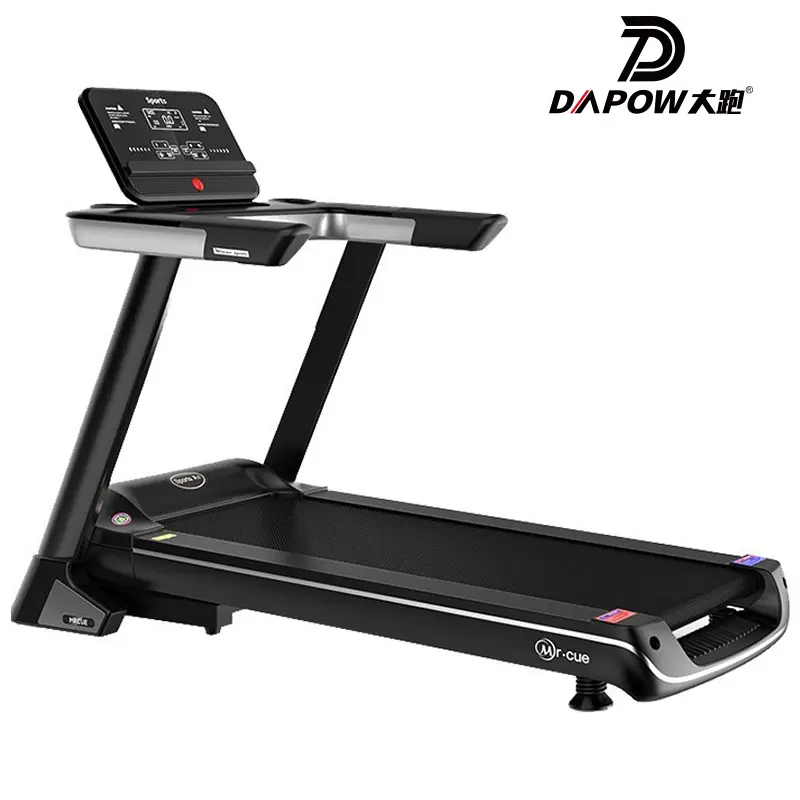
Traditional treadmills employ complex “multi-layered” shock absorption systems. High-end models feature multi-stage elastic suspension pads, air chambers, or rubber columns beneath the deck. When your foot strikes, impact is absorbed, cushioned, and partially rebounded by these elastic components. This active, systematic engineering disperses joint impact evenly. Some premium commercial models even allow adjustable damping to accommodate different weights and training types.
Walking mats, however, lean more toward “structural damping” and “postural damping.” First, their typically shorter, lower-to-ground tracks transmit less vibration due to structural rigidity. More importantly, since walking involves active effort, your gait feels more natural. This allows better control over landing force and angle when your foot strikes the mat, reducing the jarring sensation of “stomping down.” Many walking mats emphasize “mimicking the feel of grass or sand.”
Data supports this: A rehabilitation study on joint replacement patients showed that those exercising on walking mats reported approximately 30% less subjective knee discomfort than those using traditional treadmills (even at low speeds). This strongly correlates with the active-power movement pattern. Therefore, if your procurement targets senior communities, physical therapy centers, or consumers prioritizing gentle home workouts, the joint-friendly nature of walking mats presents a significant advantage. However, for runners seeking road-running simulation or endurance training, the adjustable, solid cushioning feedback of traditional treadmills remains irreplaceable.
III. Footprint and Space Flexibility: How to “Fit” into Small Spaces?
Space is a hard constraint in both commercial and home settings, yet their solutions differ dramatically.
Traditional treadmills are quintessential “space occupiers.” A full-size model typically measures over 1.8 meters in length and nearly 1 meter in width. Factoring in required clearance at the front and rear, it permanently occupies approximately 3-4 square meters of floor space. While some home models fold upright, they remain bulky, heavy “large furniture” requiring dedicated placement.
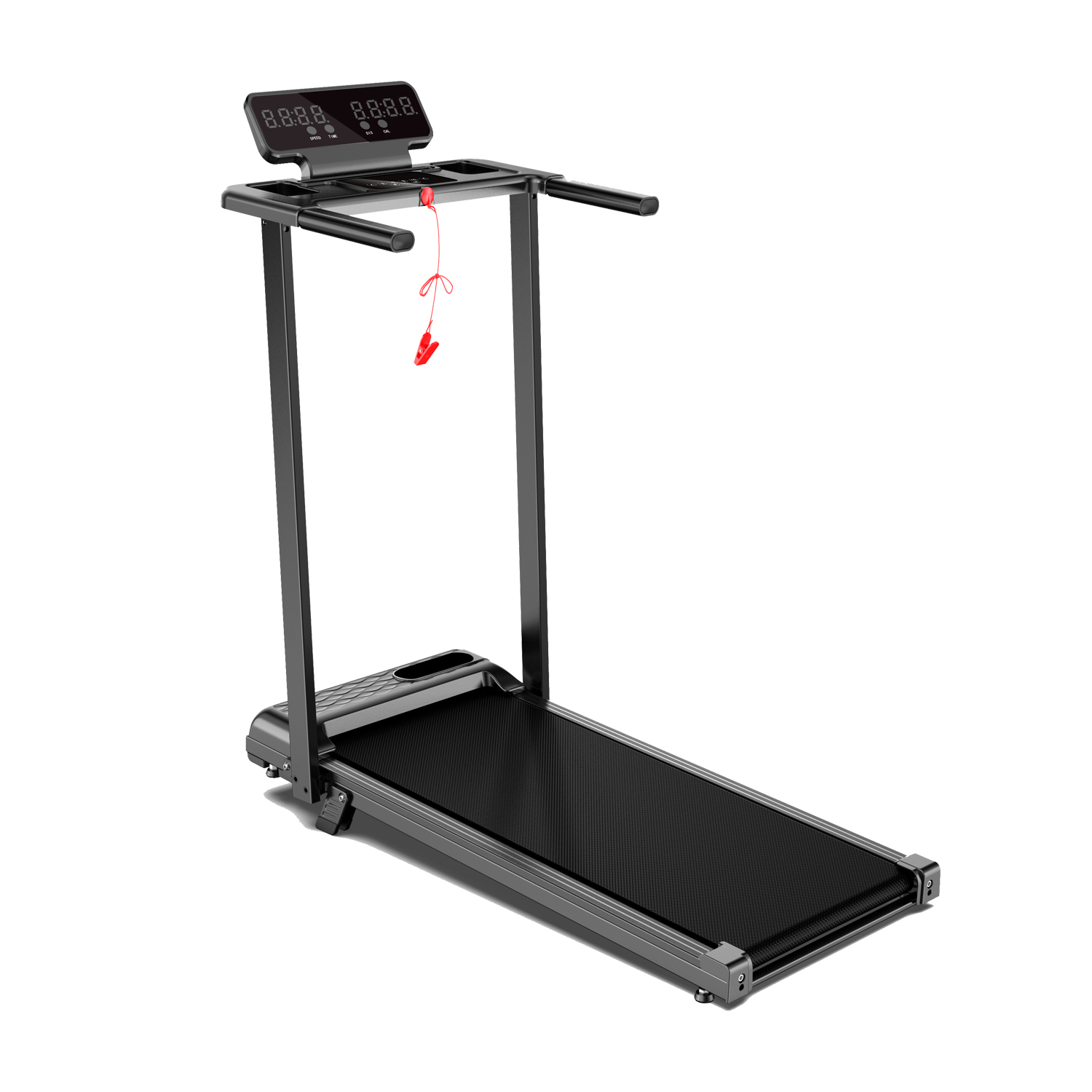
Treadmill mats, however, exemplify the “space-integrator.” Their greatest advantage lies in ultra-thin profiles and effortless storage. Mainstream mats maintain thicknesses around 10 centimeters and lengths under 1.5 meters. Post-use, they typically stand vertically against walls or tuck under beds/into cabinet crevices, requiring less than 0.2 square meters of storage space. This proves revolutionary for urban apartments, hotel rooms, compact offices, or space-constrained gyms (as supplementary areas).
A procurement case study: An emerging internet company sought to establish a fitness corner for employees despite extremely limited office space. They initially considered two folding treadmills but found them bulky and obstructive even when folded. We later recommended two foldable walking mats paired with a TV. When not in use, they stand against the wall, taking up almost no floor space. During lunch breaks, they can be pulled out for use, significantly boosting space utilization and user engagement. This distinction directly defines the product’s application scenarios: treadmills suit homes or commercial spaces with dedicated gyms, while walking mats are the perfect solution for small spaces and diverse settings.
IV. Energy Consumption and Maintenance Costs: What Does Long-Term Operation Cost?
For gym operators and savvy home users, the purchase price is only part of the equation—long-term energy consumption and maintenance represent hidden costs.
Traditional treadmills are major energy guzzlers. Their powerful motors continuously consume electricity during operation—a 3.0-horsepower commercial model can burn nearly 2 kWh per hour of continuous use. Additionally, complex drive systems, electronic displays, and motorized incline mechanisms increase failure rates and maintenance demands. Regular upkeep includes lubricating the belt, inspecting motor brushes, and calibrating speed sensors.
Walking mats offer far simpler energy consumption and maintenance profiles. With low-power motors or no motors at all (powered by human effort), their operational energy usage is extremely low—typically one-tenth or less than traditional treadmills. Their mechanical structures are also relatively simple, lacking complex speed controllers and incline motors. Primary maintenance involves keeping the tread clean and checking bearing smoothness, significantly reducing daily upkeep costs.
From a commercial operations perspective: A gym with 20 treadmills operating an average of 10 hours daily incurs substantial electricity costs. Replacing just 5 of these with walking pads for warm-up and cool-down zones could yield annual savings of thousands of dollars in electricity and maintenance expenses. For home users, treadmill mats incur virtually negligible electricity costs. Therefore, when formulating purchase plans, long-term ownership costs must be factored in, not just the initial unit price.
V. Noise Levels and Neighborly Considerations: Will Running Upstairs Trigger Complaints?
This final distinction may directly determine whether a product sees frequent use in China’s typical residential building environments.
Traditional treadmills are widely recognized as “noise generators” . Noise sources are complex: the hum of the motor, the thud of feet striking the deck, and structural low-frequency vibrations transmitted through the floor. This low-frequency noise penetrates exceptionally well, significantly impacting downstairs neighbors—a key reason many home treadmills end up as clothes racks.
Walking mats inherently excel in quiet operation. First, motor noise is virtually nonexistent or extremely faint. Second, the active propulsion mechanism minimizes impact, resulting in quieter footfall. Most importantly, their ultra-thin design typically minimizes floor contact area, and their lightweight construction prevents strong structural vibrations. Many users report that those below can barely hear the treadmill in operation upstairs.
This is precisely why treadmills are the go-to choice for many apartment fitness equipment buyers. One community fitness equipment distributor we partnered with saw treadmill mats as their top-selling product, with marketing that hit the pain point: “Come home late after overtime? Walk for a while without worrying about disturbing family or neighbors.” If your procurement targets urban apartment dwellers, hotels (to avoid guest complaints), or office environments, noise level must be a key decision factor—and treadmill mats excel here.
Choosing between a treadmill mat and a traditional treadmill is never a simple matter of good versus bad, but rather one of precise needs matching. The core difference between treadmill mats and traditional treadmills lies in their fundamentally distinct design philosophies: one is an active tool that follows your body, while the other is a powerful machine that provides propulsion. In summary:
- Seeking ultimate quietness, space efficiency, joint-friendliness, low-intensity cardio, and low maintenance? Treadmill mats are the superior solution.
- Requiring professional running training, high-intensity intervals, precise data control, and solid shock absorption? Traditional treadmills remain irreplaceable.
Understanding these five points empowers you to make the smartest, most cost-effective purchasing decisions for diverse clients or venues.
FAQ
Q1: Are the speed and incline of walking pads sufficient for effective workouts?
A1: Effective workouts depend not on absolute speed, but on heart rate and duration. Most walking pads support brisk walking and jogging speeds of 4-6 km/h, which is sufficient to elevate heart rate into the aerobic fat-burning zone. Regarding incline, high-end walking pads feature electric adjustment capabilities. While the range may not match that of treadmills, increasing incline significantly boosts exercise intensity. For general fitness and weight management, their effectiveness is entirely sufficient; however, they have limitations for professional training focused on peak speed and endurance.
Q2: What about the weight capacity and durability of walking pads? Can they be used in commercial gyms?
A2: Home-use walking pads typically have a weight capacity around 120 kg, sufficient for the vast majority of users. Commercial-grade models feature reinforced frames and motors, supporting over 150 kg. However, they remain optimized for moderate-to-low intensity, high-duration aerobic use—ideal for gym “warm-up zones,” “cool-down areas,” or “rehab sections.” While not a suitable replacement for traditional commercial treadmills in high-intensity running training, they serve as an excellent product line complement for diverse needs.
Q3: From a procurement perspective, how do walking pads compare to traditional treadmills in terms of profit margins?
A3: Their business models differ. Traditional treadmills have higher unit prices but also incur significant transportation, warehousing, installation, and after-sales costs. While individual profit margins are substantial, inventory turnover may be slower. Walking mats have lower unit prices, but their compact size, low logistics costs, and minimal failure rates enable faster inventory turnover and reduced after-sales pressure. For distributors, walking mats serve as traffic-driving products to attract new customers and tap into small-space markets, complementing traditional treadmills to optimize overall profit structures.
Meta Description: A deep dive into the core differences between walking mats and traditional treadmills. This guide evaluates five key dimensions—power source, joint impact, space requirements, energy consumption, and noise levels—to provide professional decision-making insights for fitness equipment buyers, wholesalers, and gym operators. It empowers precise market alignment and optimized product selection.
Keywords: Walking mats vs. traditional treadmills, quiet walking mat procurement, low-impact cardio equipment, apartment-friendly fitness gear, treadmill buying guide
Post time: Jan-26-2026