

Innovations in Folding Technology: How They Impact Treadmill Shipping and Storage Costs
An online fitness equipment retailer discovered that nearly 30% of treadmill returns stemmed from difficulties encountered during home installation—customers complained about oversized packaging that was hard to carry upstairs, confusing assembly manuals, and sometimes even refused delivery due to scratches caused during handling.
For cross-border sellers, wholesalers, and even large gym purchasers, the troubles posed by bulky treadmills extend far beyond installation. The ripple effects of their massive packaging dimensions permeate every stage—from international shipping and local warehousing to final delivery—silently eroding profits. Each surge in logistics costs or shortage of storage space compels the industry to seek better solutions.
The core issue lies in the product’s physical form. In recent years, true innovation in treadmill folding technology has addressed these “logistics pain points” by systematically tackling the physical form itself. This article breaks down the costs across freight, warehousing, and end-user delivery to show how advanced folding designs tangibly reduce your overall operational expenses.
01 International Shipping: Squeezing Profit from Cubic Volume
The core billing basis for international sea or air freight is the “chargeable tonnage”—calculated as the greater of the actual weight or the volumetric weight of the cargo. For traditional treadmills, that bulky, non-compressible cardboard box means you’re constantly paying hefty shipping costs for “air.”
Comparative data from logistics firms reveals that a typical non-folding commercial treadmill’s packaging volume is approximately 2.2 cubic meters. In contrast, a similarly sized home treadmill with a vertical full-folding design reduces packaging volume to around 1.1 cubic meters. This nearly doubles the loading capacity of a single container.
Let’s crunch the numbers: Assuming a 40-foot high cube container has an effective volume of about 76 cubic meters. Loading traditional treadmills (2.2m³/unit) yields roughly 34 units; loading advanced folding models (1.1m³/unit) theoretically allows for 69 units. While actual loading may be affected by weight and other factors, the improvement in transportation efficiency is substantial. This means the shipping costs, port handling fees, and other expenses allocated per treadmill unit will decrease significantly, creating valuable pricing flexibility for your products in target markets.
Common Question: Does folding the machine so compactly compromise the running area size or structural rigidity?
That’s a decade-old misconception. Modern high-end folding technology (e.g., hydraulic soft-close, multi-point locking systems) operates on the principle of “unfolded when in use, folded when not.” When extended, precision mechanical locks and reinforced support structures ensure the running deck’s stability and overall rigidity match non-folding models. Folding occurs only during non-use, leaving core performance unaffected. When selecting, focus on the design of the extended locking mechanism and weight-bearing test reports.
02 Warehousing and Inventory Turnover: Enhancing Space Utilization and Capital Efficiency
Upon arrival at overseas or local warehouses, challenges shift from transportation to storage. Warehousing costs are calculated based on occupied “storage space” and “duration.” Traditional treadmills, due to their substantial “footprint,” perpetually consume costly storage resources.
Folding treadmills directly optimize costs in two ways by reducing storage volume. First is physical space efficiency. In a 1,000-square-meter warehouse, storing traditional models requires wider aisles and operational space. Stackable or densely stored folding models increase storage density by approximately 30%-50%. This not only directly reduces monthly storage rent per unit but also allows you to stock more inventory in the same space.
Second is capital turnover efficiency. Reduced storage space requirements mean you can use the same warehouse budget to stock a wider variety of models or colors, thereby lowering the risk of slow-moving inventory for any single model. More importantly, when your products are sold through Amazon FBA or similar platforms, a smaller “FBA volume weight” directly translates to lower monthly inventory storage fees and more affordable order fulfillment costs. This represents a direct cost benefit from platform rules.
A real-world example comes from a manufacturer exporting to Europe. They designed a specialized “warehousing mode” for their best-selling folding treadmill series—shipping them in a semi-folded state secured with straps. This reduced their European overseas warehouse monthly storage costs by 22% year-over-year while boosting inventory turnover by 18% due to faster order fulfillment.
03 The End-User “Last Mile”: Tackling the Largest Hidden Cost
While international shipping costs can be clearly calculated, the “last mile” delivery and installation from local warehouses to consumers’ homes is fraught with uncertainty and high hidden costs. This is precisely where folding technology delivers immense value.
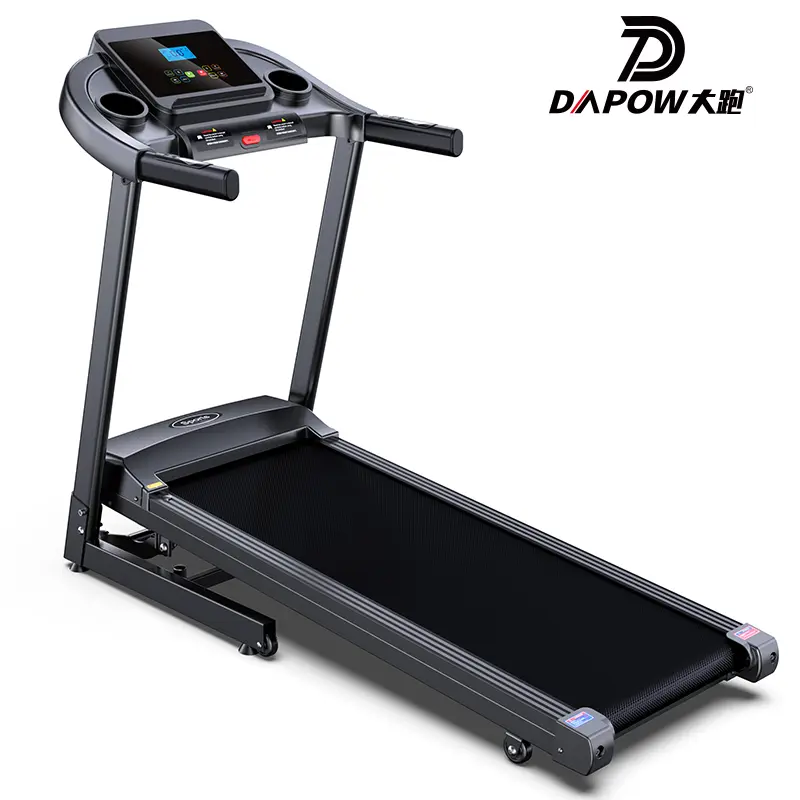
Traditional treadmills often fail to fit through standard residential elevators or stairwell corners, necessitating costly “manual stair-carrying fees” or even crane operations—sending single-delivery costs soaring by hundreds of dollars. A well-designed foldable treadmill, however, can reduce its width and length to the size of a single-person sofa when folded.
This size optimization delivers three direct benefits: First, it fits through most standard elevators and doorways, eliminating extra moving fees. Second, a single person can handle basic relocation, reducing delivery difficulty and damage risk. Third, it simplifies the unboxing-to-use process. Many modern folding treadmills feature “tool-free assembly”—users simply unfold the unit, engage the safety lock, and secure the upright column before use, thereby waiving installation fees.
For B2B clients (hotels, small gyms, corporate wellness programs), this convenience is equally vital. They can deploy equipment more flexibly in limited rooms or spaces, and easily relocate machines during deep cleaning or layout adjustments, enhancing operational flexibility.
04 Selection & Evaluation: Identifying Truly “Cost-Friendly” Folding Designs
Not all treadmills marketed as “foldable” deliver the aforementioned cost efficiencies. As a procurement specialist, you must look beyond marketing claims to evaluate the “logistics-friendliness” of their folding designs.
Focus on these specific design details:
Folded Dimensions: Directly request the folded packaging dimensions (length, width, height) and calculate its volume. Compare this against competitors or traditional models—it’s the hard metric that impacts all logistics costs.
Ease and safety of folding operation: Ideal folding mechanisms feature hydraulic assistance and one-touch controlled descent, preventing user strain, injury, or poor experience. This directly impacts end-user satisfaction and return rates.
Factory shipping configuration: Confirm whether products ship fully assembled (READY TO RUN) or require simple destination assembly. While the former may have slightly larger initial packaging, it eliminates installation costs and risks entirely—requiring comprehensive trade-off analysis.
Packaging Protection and Recyclability: Superior folding designs incorporate custom-fit liners and reinforced packaging points to ensure protection during compact shipping. Simultaneously, minimalist packaging using recyclable materials is emerging as a win-win solution for reducing packaging costs while aligning with environmental sustainability trends.
A noteworthy example is an international brand that introduced “toolbox-style” packaging for its premium folding series. Core components like the running deck and control console are individually reinforced and nested within a compact case. This design not only reduced damage rates by 70% but also maximized storage and handling efficiency, becoming a key factor in lowering overall operational costs.
Returning to the original question, innovations in folding technology are far from mere marketing gimmicks. They represent a systematic cost optimization project spanning the entire product lifecycle. Starting at the design stage, ingenious mechanical structures reduce static product volume, thereby lowering sea and air freight costs during international shipping, improving space utilization in warehousing, and avoiding high surcharges in last-mile delivery. For savvy buyers, evaluating a treadmill’s value shouldn’t focus solely on the FOB factory price. Instead, calculate its “total cost of ownership upon arrival.” A truly exceptional folding treadmill proves itself as a reliable partner delivering predictable savings within this total cost equation.
Three Most Frequently Asked Questions (FAQ) for Buyers and Sellers
1. Is the folding mechanism prone to damage? Are repair costs high?
Modern high-quality folding hinges typically undergo durability testing exceeding tens of thousands of cycles—far surpassing typical household usage. The key is selecting mechanisms with hydraulic dampers and metal latches, avoiding purely mechanical spring designs. Failure rates are now minimized, and most manufacturers include the folding mechanism in their core warranty coverage.
2. Are folding treadmills suitable for commercial settings (e.g., small gyms)?
This depends on usage intensity. Commercial-grade folding treadmills are now available, featuring thicker steel construction, industrial-grade hinges, and motors with higher continuous horsepower to withstand heavier use. They are fully viable for low-to-medium intensity commercial settings with 4-8 hours of daily use, offering the unique advantage of spatial flexibility.
3. How can the value of foldable design be effectively communicated to end consumers to justify higher prices or boost sales?
Shift marketing focus from “foldable” to “saving you time and money.” Use visual comparisons to demonstrate packaging size and elevator accessibility, calculating potential savings on “installation fees” (typically $50-$150). Emphasize the instant gratification of “unbox and run—no installer needed,” effectively addressing consumer pain points.
Meta Description: Deep dive into how treadmill folding technology innovations systematically reduce cross-border trade costs in shipping, warehousing, and last-mile delivery. This article provides buyers and sellers with a comprehensive evaluation framework—from packaging volume and FBA fees to installation costs—to help you select fitness equipment that genuinely reduces total operational expenses. Read now to optimize your supply chain decisions.
Keywords: treadmill folding technology, fitness equipment shipping costs, treadmill storage efficiency, last-mile delivery, folding treadmill procurement
Post time: Jan-28-2026