

Cost-benefit Analysis: One-time Investment in “Commercial Treadmills” or “Heavy-Duty Household Treadmills”?
In the past two years, when discussing equipment planning with gyms, hotel fitness centers and high-end apartment properties, more and more people have been stuck on the same question – should they invest in “commercial treadmills” all at once or take a step back and choose “heavy-duty home treadmills”? On the surface, it seems to be about choosing a model, but in reality, it’s about calculating a “long-term holding account”.
The idea behind running volume is quite simple: commercial treadmills, from motor power, load-bearing structure to running feel stability, are all designed based on continuous operation for several hours every day. Heavy-duty household machines, on the other hand, are more like “enhanced household models”, with solid materials, but their design lifespan and operational intensity ceiling are significantly lower. If one only looks at the figures on the purchase order, the latter seems to be more “cost-effective”. However, when it comes to operational scenarios, the balance of cost-effectiveness often tilts in favor of commercial use.
Let’s start with the hard indicator of density. The structural components, transmission systems and control systems of commercial treadmills are matched according to high frequency and multiple person-times of load. For instance, the redundancy of the motor is usually sufficient. Even if it runs continuously for one or two hours, there will be no significant speed reduction or overheat protection. The thickness of the elastic layer of the running board and the distribution of the shock-absorbing modules can maintain a consistent foot feel among users of different weights and step frequencies, reducing the wear and tear of the equipment itself. Although heavy-duty household machines can withstand occasional intense exercise, under the high-frequency use day after day, the motor lifespan, belt tension, and bearing wear will approach the critical point more quickly, and the maintenance frequency will naturally increase.
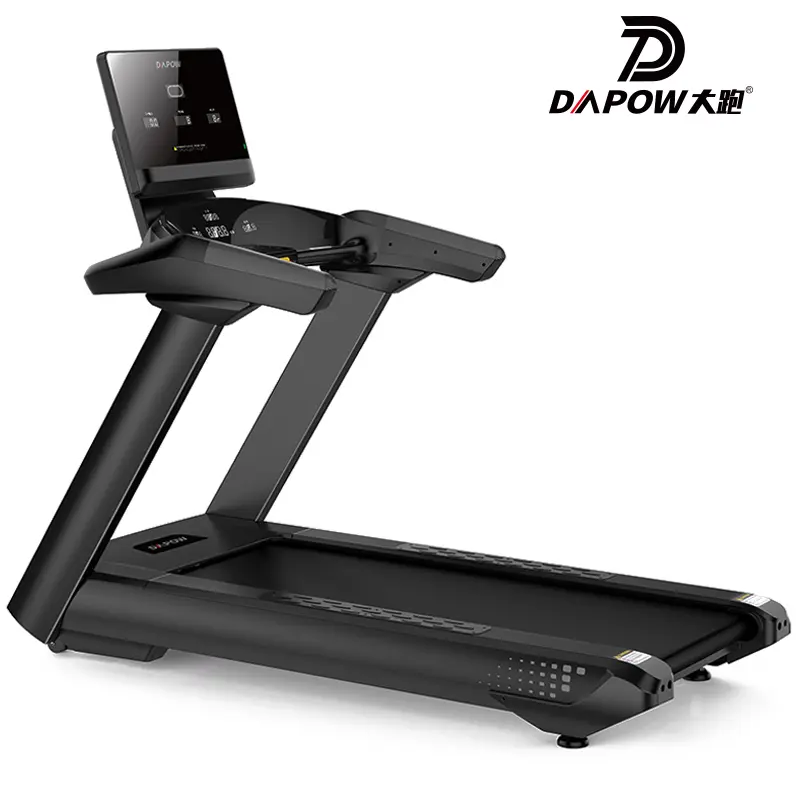
Let’s talk about maintenance and shutdown costs again. The modular design of commercial treadmills makes the replacement of common wear parts more time-saving. Many components can be found as universal or interchangeable parts in the local market, which is crucial for places that need to ensure business hours. The maintenance chain for heavy-duty household machines is relatively narrow. Once core drives or structural components are involved, they may need to be returned to the factory or wait for imported parts. A few days of downtime means a profit gap. For B-end customers, the availability rate of equipment is directly related to cash flow and customer satisfaction. This difference may be reflected on the books as an implicit benefit of “fewer business interruption losses”.
The balance between energy consumption and durability is also worth careful consideration. Commercial treadmills, being designed for high-intensity operation, often undergo optimization in energy efficiency management, such as intelligent load regulation and multi-speed control, which can reduce ineffective power consumption under different usage conditions. The energy consumption of a single use of a heavy-duty household machine may not be much higher, but if it is under a medium to high load for a long time, the overall electricity consumption and maintenance costs combined will offset the initial purchase price difference within two to three years.
Another often overlooked aspect is scalability and compliance. Many commercial scenarios need to meet certain safety standards and certification requirements. Commercial treadmills are already equipped with relevant protection and detection mechanisms during the design stage, such as emergency stop response, overload protection, and anti-slip stability. This can reduce the need for later modifications or additional investments to comply with regulations. Heavy-duty household machines are more based on the safety Settings of the home environment. When placed in commercial Settings, more efforts may be needed in management and supervision, indirectly increasing labor and risk control costs.
So, returning to the essence of cost-effectiveness – if your venue has a high usage frequency, large user mobility, and you hope that the equipment maintains a stable availability and consistent experience throughout its entire life cycle, making a one-time investment in a “commercial treadmill” is often a more reliable choice. Although it has a high initial investment, it can spread the comprehensive cost down to each operation with a lower failure rate, higher usage efficiency and less downtime loss. However, if the usage intensity is low, the budget is sensitive, and it mainly targets a fixed group of people, then heavy-duty home machines can also complete tasks in specific scenarios, but they need to have more proactive contingency plans in terms of maintenance and replacement rhythms.
Post time: Dec-10-2025