

Corporate Gym Solutions: How to Choose the Right Fitness Equipment for Employees
Many companies either buy expensive full-commercial heavy machines that crowd the space and raise maintenance costs, or choose pure home-use models that cannot withstand frequent use and break down within six months.
Eventually, the gym becomes a neglected storage corner.
This article breaks down how to find the best balance between durability and cost-effectiveness, focusing on selection strategies for home and light commercial fitness equipment.
We help you build a highly efficient workplace wellness space with excellent employee satisfaction, turning every investment into real productivity.
Usage Scene Matching: Why Light Commercial Models Are the “Golden Solution” for SMEs?
However, for most small and medium-sized enterprises or department-level fitness corners, daily usage is usually 20–50 people, with short single-use durations.
For such low-to-medium frequency scenarios, industrial-grade heavy equipment is completely unnecessary.
These machines use thicker frames and higher Continuous Horsepower (CHP) motors than home treadmills, perfectly handling continuous operation during morning and evening rush hours.
At the same time, they are 30% smaller than full-commercial models, greatly saving valuable office space.
At first, they purchased a top-of-the-line full-commercial treadmill brand.
Due to the large size, only 4 machines fit into their 30㎡ gym area, making the space cramped and underused by employees.
In the same area, they neatly arranged 8 machines plus elliptical trainers and spin bikes.
Data showed that employee midday workout participation increased by 140% after the upgrade.
Is the lifespan of light commercial equipment really sufficient?
Energy consumption is only half that of full-commercial machines, delivering real cost reduction and efficiency improvement.
Core Parameter Pitfall Avoidance: How to Identify Durable Motors & Shock Absorption Systems?
Focus on the “heart” and “skeleton” of the machine.
For corporate environments, always focus on Continuous Horsepower (CHP), not peak horsepower.
We recommend starting with a brushless DC motor of at least 2.5 CHP to ensure no overheating or speed drop during continuous use by multiple people.
Employees running on hard surfaces for long periods risk knee injuries, which can lead to workplace disputes or increased sick leave.
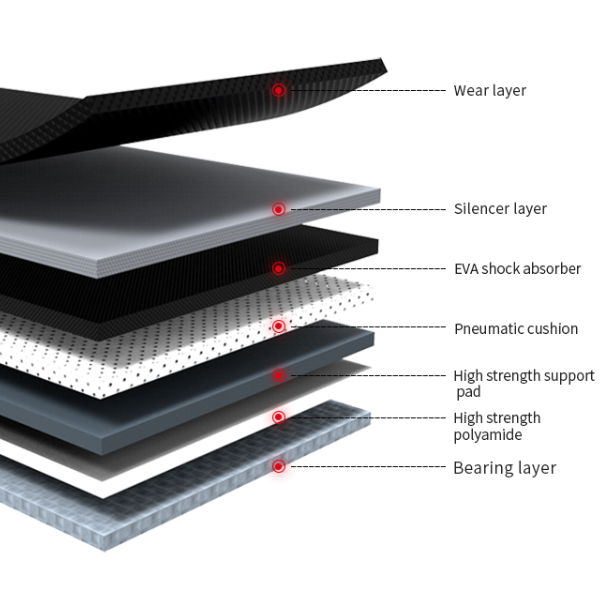
High-quality light commercial equipment uses a multi-stage cushioning suspension system that effectively absorbs over 60% of impact force.
Why are some machines half the price with similar-looking parameters?
Low-cost models often use recycled steel and ordinary rubber running belts.
After three months of use, noise increases sharply, vibration transfers to the floor, and complaints arise from downstairs departments.
For example, a well-known light commercial series uses aviation-grade aluminum brackets and independent suspension pads.
Even under full load, noise is controlled below 60 decibels, without disturbing nearby office meetings.
Focus on whether the motor runs smoothly under high load—this is the most intuitive way to judge overstated specifications.
Operation & Maintenance Cost Control: How to Reduce Long-Term Costs with Smart Management?
For administrators, the biggest headache is broken equipment with no timely repair, or low usage because employees do not know how to operate machines.
Modern smart equipment supports remote diagnosis, usage frequency statistics, and automatic firmware updates.
Managers can view peak hours and popular equipment types through backend data to optimize schedules or rearrange layouts.
A multinational manufacturing company in Shanghai introduced a group of fitness equipment with a cloud-based management system.
They used the data report to apply for one additional light commercial treadmill, precisely solving the pain point.
Will smart functions increase the procurement budget?
After all, a stably running fitness facility is the best testament to corporate care for employees.
FAQ
Q1: What is the biggest difference between home treadmills and light commercial treadmills in corporate settings?
Home treadmills are designed for 1–2 hours of daily intermittent use.
Light commercial treadmills can withstand over 8 hours of high-frequency start-stop usage per day, with more stable frames and better motor heat dissipation, making them ideal for shared corporate environments.
Q2: Which equipment should be prioritized if office space is limited?
These provide core cardio functions while maximizing vertical space.
They are also easy to move and rearrange flexibly for different activities.
Q3: How to ensure employees use equipment safely and correctly after purchase?
Data shows that simple guidance reduces equipment misuse by 80% and significantly extends service life.
Conclusion
Choosing suitable home and light commercial models not only saves costs for the company but also provides employees with long-lasting, safe health protection.
A well-designed corporate gym truly becomes a core engine for attracting talent and boosting workplace vitality.
Meta Description (SEO Optimized)
Core Keywords (Google SEO Friendly)
Post time: Mar-05-2026